
Pace tells you how long one kilometre or one mile takes. Speed tells you how much distance you cover in one hour. Finish time is the total duration for the whole distance. They describe the same movement, but the units point in opposite directions: a lower pace is faster, while a higher speed is faster.
The safest way to move between them is to keep one unrounded distance and one unrounded duration, calculate the missing value, and round only the answer you show. This avoids the seconds of drift that can appear when a rounded pace is reused repeatedly.
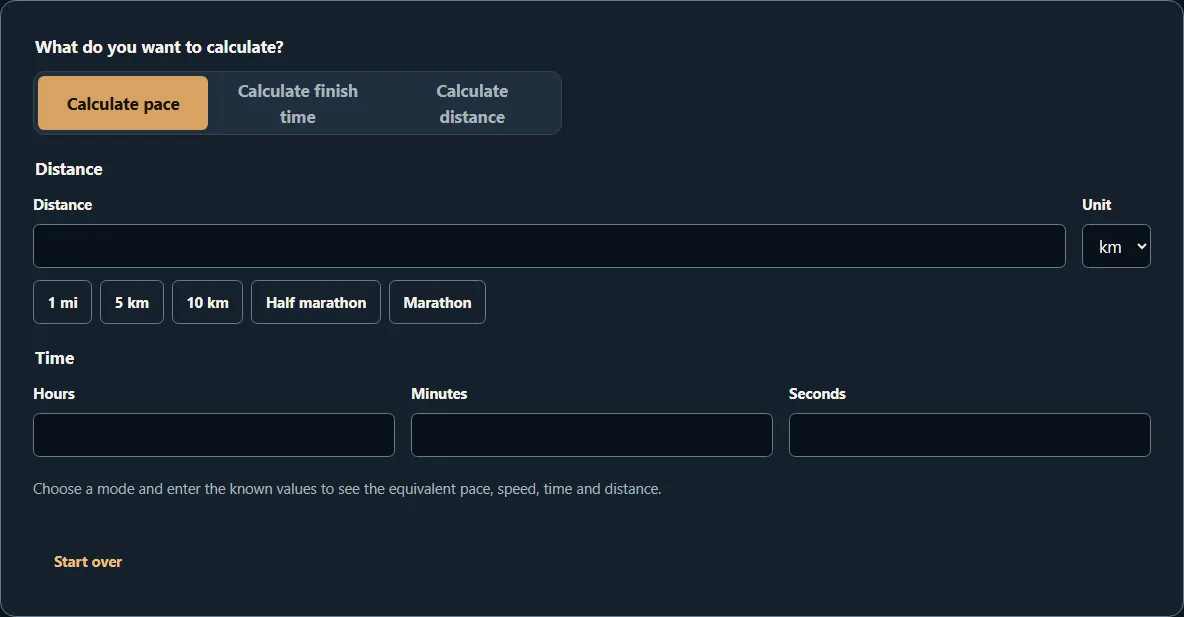
Lutrakit’s Pace Calculator exposes all three directions in one local interface. It sends no input to Lutrakit, keeps the exact value for the calculation, and rounds only the displayed result. After a successful calculation, Copy calculation link writes a same-page URL containing the bounded calculator state to the clipboard. Opening that URL restores the mode, units and input fields; copying it does not send the calculation to a server.
Start with the two values you actually know
Every useful calculation starts from one of three pairs:
| You know | You can calculate |
|---|---|
| Distance and elapsed time | Pace and speed |
| Distance and pace or speed | Finish time |
| Elapsed time and pace or speed | Distance |
Keep the unit beside every number. A value such as 5:00 is incomplete by
itself: it could mean five minutes per kilometre, five minutes per mile, or a
five-minute total duration. Likewise, 10 could be kilometres, miles or a
speed.
This article uses the international mile, which is exactly 1,609.344 metres in the NIST conversion table. The BIPM SI Brochure defines the metre and the second used behind the calculation. A kilometre is 1,000 metres, one minute is 60 seconds and one hour is 3,600 seconds.
Calculate pace and speed from a 10 km time
Suppose the distance is 10 km and the elapsed time is 50 minutes.
First convert the duration to one unit:
50 minutes × 60 = 3,000 seconds
Pace per kilometre is total time divided by distance:
3,000 seconds ÷ 10 km = 300 seconds per km = 5:00 min/km
Speed uses distance divided by time. Fifty minutes is five-sixths of an hour:
10 km ÷ (50 ÷ 60 hours) = 12 km/h
For mile units, convert the same underlying distance instead of rounding 10 km
to 6.2 miles. Ten kilometres is approximately 6.2137 international miles. The
same 3,000-second duration therefore gives about 482.8 seconds per mile, which
rounds to 8:03 min/mi, and about 7.46 mph.
These four outputs describe one result:
| Representation | Result |
|---|---|
| Pace | 5:00 min/km |
| Pace | 8:03 min/mi |
| Speed | 12 km/h |
| Speed | 7.46 mph |
The small difference between the exact value and the displayed value is
normal. The displayed 8:03 min/mi should not replace the exact duration and
distance inside the next calculation.
Calculate finish time from pace
To calculate a finish time, multiply the distance by the time required for one unit of that distance.
At 5:00 min/km, the pace is 300 seconds per kilometre. A marathon is 42.195
km, so the reproducible calculation is:
42.195 × 300 = 12,658.5 seconds
That is 3 hours, 30 minutes and 58.5 seconds. Rounded to the nearest whole
second, the finish time is 3:30:59.
This is a mathematical projection at a constant pace, not a performance forecast. It does not account for hills, turns, weather, fatigue, aid stations, GPS error or the difference between a certified course and a device reading. Use it to plan or compare numbers, not to claim that a person will achieve that time.
Calculate distance from time and speed
The reverse calculation is useful when a fixed session duration and speed are known. Multiply speed by time expressed in hours.
For 45 minutes at 12 km/h:
45 minutes ÷ 60 = 0.75 hours
12 km/h × 0.75 hours = 9 km
You can verify the answer from pace. A speed of 12 km/h is 5 minutes per kilometre, and 45 minutes divided by 5 minutes per kilometre also gives 9 km. Two calculation paths reaching the same result are a useful check against a unit mistake.
Convert pace without treating minutes as a decimal
Clock notation is not ordinary base-10 notation. A pace of 4:30 min/km means
4 minutes and 30 seconds, or 270 seconds. It does not mean 4.30 minutes:
0.30 of a minute is only 18 seconds.
Convert the complete pace to seconds before changing units:
4 × 60 + 30 = 270 seconds per km;- multiply by
1.609344to cover one mile; 270 × 1.609344 = 434.52288 seconds per mile;- convert back to clock notation: approximately
7:15 min/mi.
This is also why converting a rounded text label can disagree by a second with a calculator that retains the exact value. The correct approach is to preserve the precise internal value and round each displayed unit independently.
Use standard race distances precisely
For a rough personal plan, a rounded distance may be enough. For a comparison against a standard road distance, use the complete value:
- road mile: 1 international mile;
- 5 km: 5 kilometres;
- 10 km: 10 kilometres;
- half marathon: 21.0975 kilometres;
- marathon: 42.195 kilometres.
The World Athletics competition rules list the road mile, 5 km, 10 km, half marathon and marathon among the official road distances for which world records are recognized. That does not make every event course certified, and it does not make a phone or watch measurement exact. Check the event’s own published distance when the calculation is for a specific race.
Verify a result before using it
Use this short check:
- Write the distance unit beside the distance.
- Write the pace or speed unit in full.
- Convert clock values to seconds before arithmetic.
- Recalculate through a second path when possible.
- Round only the displayed result, not every intermediate step.
For the 10 km example, 5:00 min/km × 10 km = 50:00. The units cancel in the
right direction and reproduce the original duration. If multiplying makes the
unit mismatch, or if a faster effort produces a larger minutes-per-kilometre
number, revisit the inputs.
When another person needs to reproduce the same setup, copy the calculation link only after checking the result. The link contains the entered calculator state in its query string, so treat it as shareable text: inspect it before sending it and avoid putting sensitive information into free-form browser history or messaging systems. The decoder rejects unknown modes, units, malformed numeric syntax and unrelated query strings instead of silently hydrating partial state.
Limits of a pace calculation
A pace calculator solves a fixed distance–time relationship. It cannot decide whether a target is suitable, safe or realistic. It cannot infer training readiness, medical risk, race strategy or the effect of a particular course.
Short GPS samples, tunnels, tall buildings, sharp turns and device smoothing can make an instantaneous pace fluctuate. Manual treadmill values and race course markings are different measurement sources. Keep the source of the distance and time with the result when precision matters.
If the task is to record actual laps, use the Stopwatch. If the task is to subtract one clock time from another, use Time Duration. Use pace math when the question links a distance, a duration and a rate.
Sources
- Bureau International des Poids et Mesures, The International System of Units (SI), 9th edition, updated 2026.
- NIST, Guide to the SI, Appendix B.8: Factors for Units Listed Alphabetically.
- World Athletics, Competition and Technical Rules - 2026 Edition and 2026 Label Road Race Regulations.