
A calendar quarter is easy: Q1 is January–March, Q2 is April–June, Q3 is July–September and Q4 is October–December. A fiscal quarter depends on the organization’s fiscal year. The same date can be calendar Q1 and fiscal Q4 if the fiscal year starts in April.
Lutrakit’s free Quarter Finder is useful when you need a quick calendar-quarter label with no account and no spreadsheet. It calculates calendar quarters only: Q1 is January–March, Q2 is April–June, Q3 is July–September and Q4 is October–December. It does not have a fiscal-start-month setting. Use the manual fiscal-quarter method below, and always check the calendar used by the organization whose report, deadline or planning cycle you are interpreting.
International scope: this fiscal method is not tied to any country. It applies to organizations whose financial year consists of 12 fixed months divided into four consecutive three-month quarters. This model is common in many countries, but it is not universal. Always use the organization’s official calendar rather than assuming a rule from its country. The method does not apply directly to 4-4-5 or 4-5-4 calendars, 52- or 53-week years, or transition periods.
Find a calendar quarter
For an ordinary calendar year, match the month to this table. No formula is needed.
| Quarter | Months |
|---|---|
| Q1 | January to March |
| Q2 | April to June |
| Q3 | July to September |
| Q4 | October to December |
Quarter boundaries change at midnight on the first day of the new quarter in the relevant time zone. If a timestamp is near midnight, convert the time zone before choosing the quarter. Timestamp Converter and Date Format Converter can help when the source includes a time or an ambiguous numeric date.
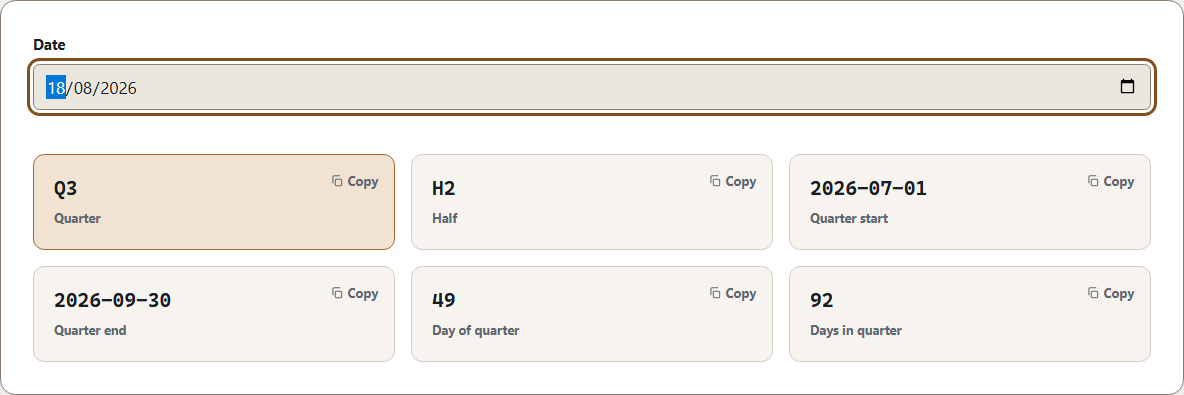
Find a fiscal quarter without a formula
First obtain the organization’s official fiscal start month. Then count forward in groups of three months: the first three months are fiscal Q1, the next three Q2, then Q3 and Q4.
For a fiscal year that starts in April:
| Period | Fiscal quarter |
|---|---|
| April to June | Q1 |
| July to September | Q2 |
| October to December | Q3 |
| January to March | Q4 |
The year label is a separate choice. An organization may name the fiscal year after the year in which it starts or the year in which it ends. Check its reports rather than guessing from the country.
Why local rules still matter
International IAS 34 on interim financial reporting covers periods shorter than a financial year, but it does not determine which entities must publish interim reports or how frequently. Those obligations are generally set by laws and regulators.
These examples show why there should not be one assumed rule per country:
- In France, many businesses can choose their closing date and a financial year usually lasts 12 months, but some activities must close on December 31 (Service-Public).
- In the United Kingdom, a company’s financial year usually lasts 12 months and ends on its accounting reference date, which can be changed under certain conditions (Companies House).
- In the United States, the IRS distinguishes calendar years, fiscal years, and 52- or 53-week tax years (IRS: Tax years).
- Some retailers use a 52-week 4-5-4 calendar, occasionally with a 53rd week; this guide’s month-based method does not apply directly (National Retail Federation).
This guide therefore calculates a quarter within an already known calendar. It does not determine tax or accounting obligations and never replaces the calendar published by the organization concerned.
Example: one date, two valid quarter labels
Take January 15, 2026.
| Calendar used | Result | Why |
|---|---|---|
| Ordinary calendar year | Q1 | January is in the first three months of the year. |
| Fiscal year starting in April | Q4 | January is in the final three-month group before April. |
If the organization labels fiscal years by their ending year, it may call this FY2026 Q4. If it labels them by their starting year, it may call it FY2025 Q4. The quarter is unchanged; only the year-naming convention differs.
Boundary cases to test
| Case | What to verify |
|---|---|
| First day of fiscal year | Should be fiscal Q1, day 1. |
| Last day before fiscal year starts | Should be fiscal Q4. |
| Leap day, 2028-02-29 | Month-based quarters handle it normally; day count does not change the quarter. |
| Fiscal start in January | Fiscal and calendar quarters match if the label convention also matches. |
| 52–53-week fiscal calendar | Do not use a simple month-quarter tool unless the organization maps weeks to periods separately. |
How to verify with Lutrakit
- Open Quarter Finder.
- Enter a date using an unambiguous format such as
2026-01-15. - Record the calendar quarter shown by Lutrakit. For
2026-01-15, it should be calendar Q1. - Do not look for a fiscal-start-month control; the current Quarter Finder does not have one.
- If you need an April-start fiscal quarter, use the manual method above and record that the fiscal result was not produced by the tool.
- If the original date came as a timestamp, convert it first in the correct time zone with Timestamp Converter.